
Osage County Release Date Meanings
Several dates can appear in one Osage County criminal case. A bond release date follows a court order and completion of jail processing. A county sentence end date depends on the judgment, jail credit, calendar computation, and any other hold. A parole eligibility or hearing date marks review, not a promised exit. The Missouri Parole Board may later set a future release date, while a conditional release date comes from the structure of an eligible state sentence.
A maximum discharge date is different again. It marks the end of the sentence and supervision unless a lawful change occurs. A person may leave prison on parole or conditional release and remain in MODOC custody in the community. Only final discharge ends that legal custody. For that reason, a record that says “release” needs both the exact label and the agency that supplied it.
Scheduled versus actual release: A scheduled date is a current plan or calculation. The actual release is proved by the jail or prison movement after every hold and condition is cleared.
Find an Osage Inmate Release Date
Start by deciding whether the person is in the Osage County Detention Center, a MODOC institution, or federal custody. These systems do not share one projected-date calculator. The county jail handles local pretrial detention and county sentences. MODOC computes state sentences and places prisoners at institutions across Missouri. A federal case uses the Bureau of Prisons locator and federal records.
- Match the person to the correct case and custodian using full name, date of birth, case number, booking number, or DOC number.
- For pretrial custody, review Case.net for the signed bond or release order, then call the jail for the physical status.
- For a county sentence, request the judgment, jail-credit facts, book-in date, and current computed end date from the jail and clerk.
- For a state sentence, search the active MODOC record, then ask the caseworker for the currently scheduled date and its label.
- Use MOVANS scheduled-release information when eligible, then watch for a later custody-change notice.
- After release, obtain the actual movement and disposition rather than relying on the earlier projection.
The Osage County released inmate lookup explains how to match the final jail movement with Case.net when the question shifts from a future date to proof of release.
Osage County Jail Release Dates
A pretrial detainee does not have a sentence-based release date. The judge may enter a bond or recognizance order, but the jail still must receive and process it. Conditions may need to be met. Another warrant or detainer can prevent community release. Case.net can show the legal event, yet only the Osage County Detention Center can confirm whether physical book-out occurred.
For a county sentence, ask the jail and Osage County Circuit Clerk for the exact judgment, sentence commencement, credit for time already served, and current end-date computation. Missouri § 558.031 addresses credit for custody related to the offense, subject to its terms. No official Osage County policy awarding a set “good time” rate was found. Do not assume one day earns another day or use a state-prison formula for a county jail term.
A local date can also change after an amended judgment, correction of custody dates, clarification of concurrent or consecutive terms, or discovery of another hold. The jail record proves when the person left Osage custody and whether the disposition was community release or transfer.
Note: A signed release order can precede the jail’s book-out timestamp, especially when conditions or other holds still require review.
MODOC Osage Release Date Search
The official MODOC Offender Search searches active offenders, including people in prison, on probation, or on parole. It asks for first and last name, includes aliases, uses a CAPTCHA, and gives a data-current timestamp. It does not provide discharged-offender information. A fully discharged person will therefore fall outside its stated public scope.
No public field labeled “Projected Release Date” or “Tentative Release Date” was verified in the landing page or official scope materials. Do not promise that a search result will display such a field. MODOC materials instead say MOVANS can provide scheduled release dates through its information system. An institutional caseworker is the direct source for a person-specific state computation.
| Source | Date or fact | Important limit |
|---|---|---|
| MODOC active search | Active prison or community-supervision status | Excludes discharged offenders; no verified projected-date field |
| Institutional caseworker | Current person-specific scheduled date | Date can change under sentence and Board rules |
| MOVANS | Scheduled date and status-change notice when available | Notification is not the final movement record |
| Case.net | Judgment, sentence, amended orders, and jail credit | Does not prove the physical prison exit |
Use the precise term returned by the source. Scheduled release, Board release, conditional release, parole eligibility, and discharge are not interchangeable.
Missouri Conditional Release Calculation
Missouri § 558.011 divides many eligible felony terms into prison and conditional-release components. For eligible terms of nine years or less, the conditional-release component is one-third. It is three years for terms between nine and fifteen years, and five years for terms over fifteen years. Specified dangerous-felony and repeat-remand categories are treated differently, and the Board may extend the prison term through the statutory process.
Conditional release is supervised. It does not equal sentence expiration. A simple fraction also cannot produce the person’s calendar date because the official computation must account for sentence start, jail credit, concurrent or consecutive structure, offense-specific exclusions, Board action, and later legal changes. MODOC, not a public calculator, must resolve those facts.
The official conditional-release statute shows the structure used for a Missouri state sentence.
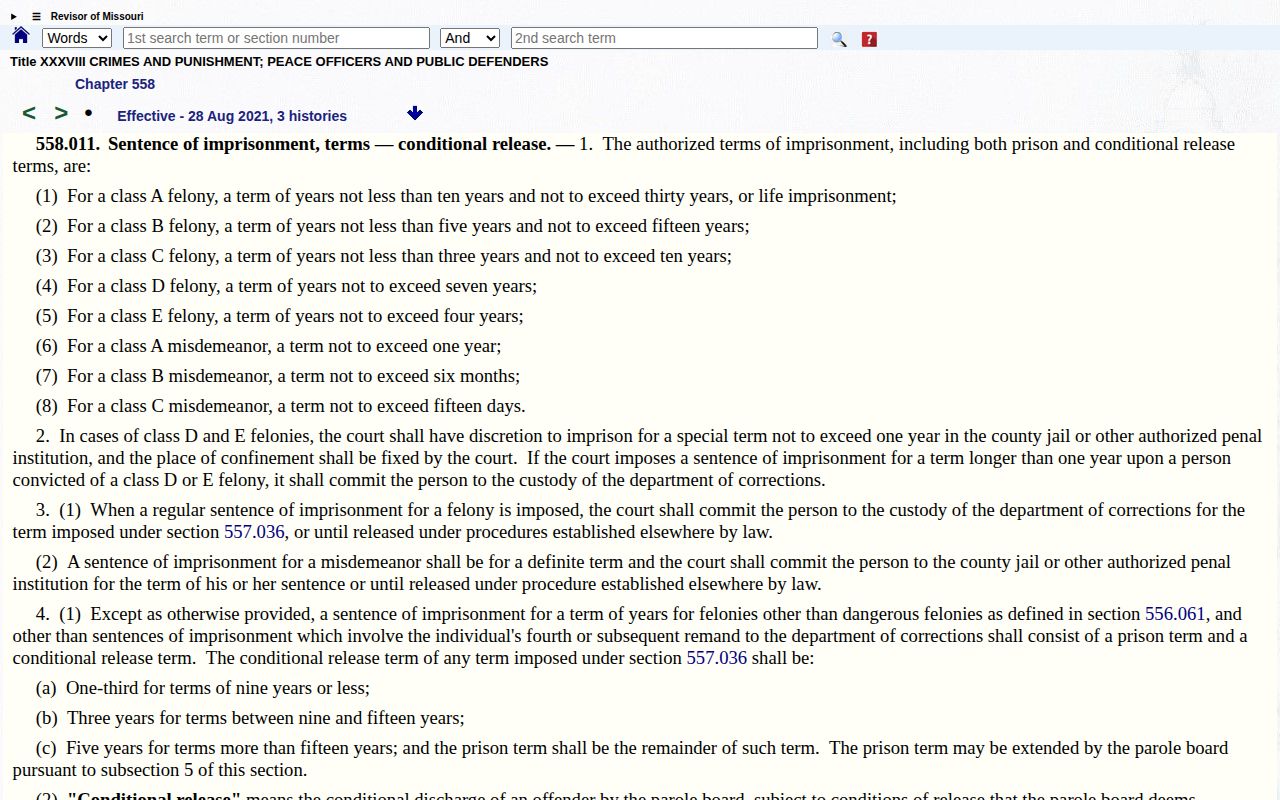
The image supports the statutory framework, but it cannot predict an individual Osage County inmate release date without the full sentence record.
Osage Release Dates and Minimum Terms
Missouri § 558.019 sets offense-specific minimum prison terms. Within the statute’s scope, a person convicted of a covered dangerous felony and committed to MODOC must serve a minimum of 85 percent of the sentence, or reach the alternate age and service threshold stated in the law. That rule concerns eligibility for parole, conditional release, or another early release path.
The same statute includes 40, 50, and 80 percent minimums for certain covered non-dangerous offenses based on prior unrelated prison commitments. It is wrong to apply 85 percent to every offense that sounds violent. The conviction statute, offense date, commitment history, and effective version of the law all matter. The judgment and official computation must control.
The official minimum-prison-term statute shows why an Osage County release date must be traced to the actual offense and legal category.
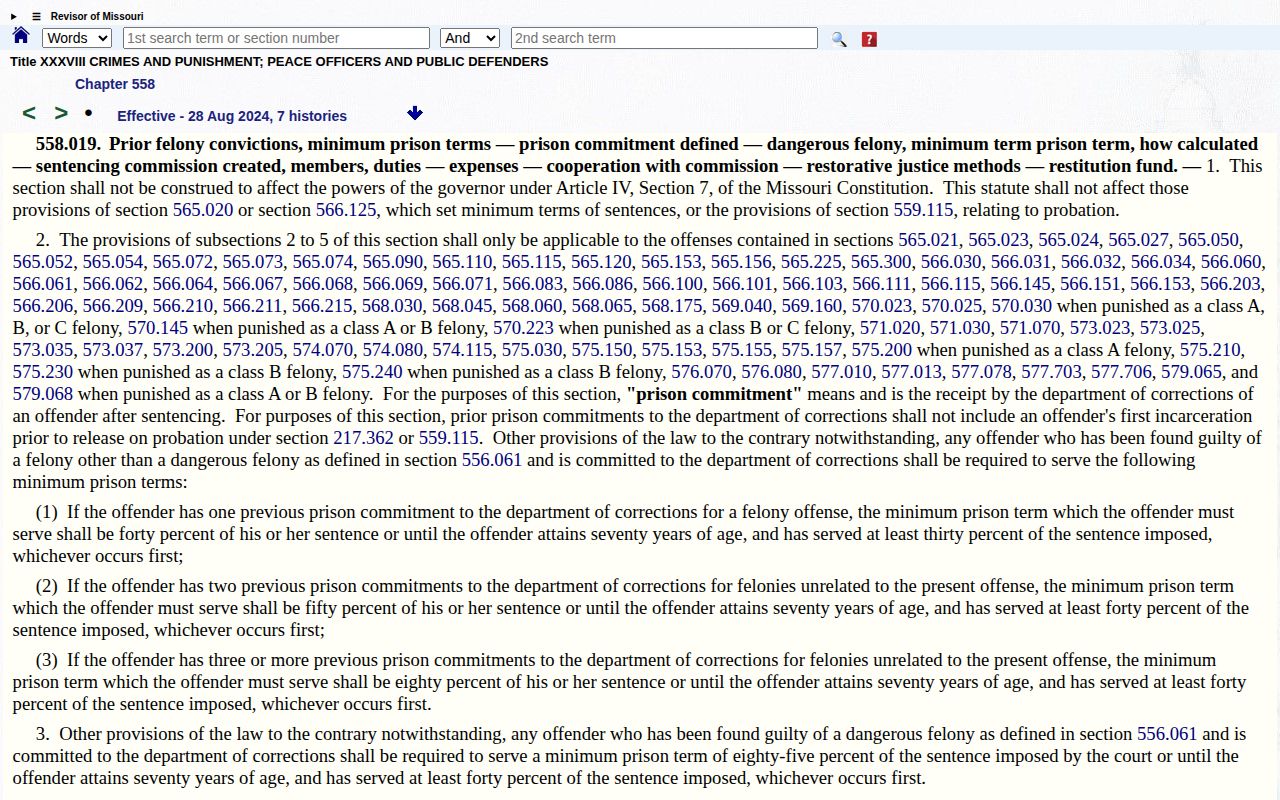
Use the statute as a limit on prediction, not as a stand-alone release-date calculator.
Note: Parole eligibility permits review; it does not guarantee a favorable Board decision or a fixed community release date.
Why Osage Release Dates Change
A projected or scheduled date is only as stable as the facts used in the computation. Some changes correct the sentence record. Others arise from later court action, Board review, institutional conduct, a violation, or another agency’s hold. The current date should always be saved with its source and “as of” time.
| Change | Possible effect | Where to verify |
|---|---|---|
| Jail-credit correction | Moves the computed sentence timeline | Judgment, clerk, jail, or MODOC |
| Concurrent or consecutive clarification | Changes how multiple terms combine | Amended judgment and sentence computation |
| Board grant, denial, or rescission | Sets, delays, or removes a parole path | Missouri Parole Board and caseworker |
| Conditional-release extension | Extends time in prison under the statutory process | MODOC and Board record |
| Warrant or detainer | May turn an expected community release into transfer | Current custodian and receiving agency |
| Violation or revocation | Can return a supervised person to custody | District 27, court, and MODOC |
| Data update lag | Leaves an old date visible for a time | Direct agency confirmation |
A BOP federal release date can also move through sentence recalculation. If the county book-out says transfer to federal custody, follow the BOP and federal court record rather than using the Missouri state formula.
Confirm an Osage Release Date
A date is not fully verified until the record shows what happened at the custody exit. For an Osage County jail event, request the person’s booking identifier, book-in date, book-out date and time, release category, and receiving agency or destination when there was a transfer. Pair that movement with the signed court order or judgment. The court explains the legal trigger, while the jail confirms the physical processing out of local custody.
For a Missouri prison term, preserve the admission date, scheduled or Board date, actual prison release date, supervision type, and later discharge date as separate fields. A person released to parole or conditional release remains in MODOC custody in the community. Final discharge may occur much later and is outside the public active search’s stated scope.
- Book-out time
- The recorded physical exit from the Osage County jail.
- Release disposition
- Community release, bond, sentence completion, or transfer to another authority.
- Supervision start
- The beginning of parole, conditional release, or probation in the community.
- Discharge date
- The formal end of the sentence or MODOC supervision term.
A transfer date must not be reported as a return to the community. Follow the receiving agency until the later community release can be confirmed.
Why Osage Release Dates Disappear
Missouri’s public offender search has an uncommon historical limit: it expressly excludes discharged offenders. A person who left prison but still serves parole or conditional release may remain searchable as active. Once the supervision term ends, the person can vanish from the public tool. That disappearance does not establish the day of release or the day of discharge.
The historical confirmation chain is direct MODOC inquiry, Case.net, and MOVANS information when available to the user. Ask MODOC for the public admission, release type, parole or conditional-release date, and supervision discharge date. Match those facts to the Osage County judgment. If the case involved only local jail custody, use the Sheriff and Circuit Clerk instead.
For an upcoming state custody change, the VINELink Release Check explains MOVANS registration and alert limits. An alert is useful, but the final prison or jail movement remains the stronger proof of the actual release.